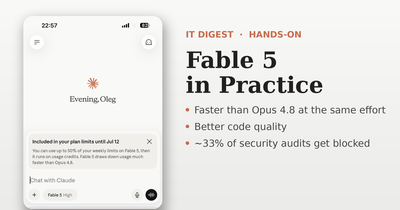
Three weeks after launch, Claude Fable 5 vanished. On June 30, Anthropic announced it's coming back — and the story of why it left and what changed on the way back is worth a developer's attention, because one of those changes will show up in your day-to-day coding sessions.
What happened
Fable 5 and Mythos 5 shipped on June 9. On June 12, the US government applied export controls to both models, requiring Anthropic to restrict access to foreign nationals inside and outside the US. With the order effective immediately and no reliable way to verify nationality in real time, Anthropic did the only thing it could: it suspended access to both models for everyone.
As of June 30, those export controls have been lifted. Fable 5 returns July 1 to users globally across the Claude Platform, Claude.ai, Claude Code, and Claude Cowork, with AWS, Google Cloud, and Microsoft Foundry to follow as fast as Anthropic can re-enable them. Mythos 5 access has been restored to a set of US organizations after government approval on June 26.
The trigger: a bypass report
The export directive followed a report from Amazon researchers who found a way around Fable 5's safeguards — prompting it to identify software vulnerabilities, and in one case producing code demonstrating how a vulnerability could be exploited.
Anthropic's follow-up testing is the interesting part for anyone tracking model capabilities. It found that many less capable models — including Claude Opus 4.8, GPT-5.5, and Kimi K2.7 — could identify the same vulnerabilities. And every model tested could reproduce the single exploit demonstration: Haiku 4.5, Sonnet 4.6, Opus 4.6, Opus 4.7, Opus 4.8, GPT-5.4, GPT-5.5, and Kimi K2.7. In other words, the technique didn't expose any unique Mythos-level cyber capability. It was a borderline case — routine defensive security work that Fable 5's cautious safeguards block out of an abundance of caution, surfaced through a bypass.
The fix — and why you'll feel it
Anthropic still moved fast. Working with the government, it trained an improved safety classifier that targets the specific behavior in the report. The technique is now blocked in over 99% of cases, and blocked requests fall back to Claude Opus 4.8 (with the user notified). Researchers at the US Department of Commerce's Center for AI Standards and Innovation (CAISI) tested both the old and new safeguards and called them extraordinarily strong.
Here's the part to plan around: Anthropic is explicit that the new classifier "comes at the cost of flagging benign requests more often during routine coding and debugging tasks." If you already budgeted for occasional Opus 4.8 fallbacks with Fable 5, budget for a few more. This is the direct, practical consequence of the redeploy — expect a modestly higher false-positive rate on ordinary security-adjacent coding until Anthropic tunes it down.
The "safety margin" model
The post gives a clearer mental model of how these classifiers behave. Rather than blocking only clearly-harmful requests, Anthropic deliberately sets the classifiers to trigger on a band of likely-benign requests too — a "safety margin" that guarantees the genuinely dangerous ones get caught. For Fable 5 that margin was set much wider than any prior launch. That's why users hit refusals on reasonable requests: it's a deliberate tradeoff to ship the model's other capabilities broadly while keeping the dangerous edge locked down.
The same margin also blunts jailbreaks. Most jailbreaks are narrow — they pop open one specific behavior and land inside the safety margin rather than reaching the core harmful capabilities. Anthropic says every Fable 5 jailbreak reported so far falls into that minor category, and that no universal jailbreak has been found (though red-teaming continues).
A shared jailbreak-severity framework
The bigger structural takeaway: there's no industry-wide way to describe how bad a given jailbreak is. Anthropic is partnering with Amazon, Microsoft, Google, and other Glasswing partners on a consensus framework that scores a jailbreak on four axes:
- Capability gain — how far beyond existing tools it takes the user
- Breadth — how many distinct offensive tasks the same technique unlocks
- Ease of weaponization — how much human effort to turn it into a real attack
- Discoverability — how easily someone can obtain the technique
For the most severe class, Anthropic says it will deploy preliminary mitigations immediately on confirmation, backed by a new team providing 24/7 monitoring of jailbreak submission channels. It's also launching a HackerOne program where researchers can submit cyber jailbreaks found in Fable 5.
Government collaboration
The final thread is deeper US government collaboration, tied to the June 2 Executive Order on advanced AI: pre-release model and safeguard access for designated government evaluators, rapid information sharing on new jailbreaks and misuse patterns, dedicated joint-research teams and compute, and work toward a common voluntary security standard across frontier model providers.
Bottom line for developers
Fable 5 is available again from July 1 — re-enable it in your integrations and Claude Code/Cowork workflows. On paid plans (Pro, Max, Team, and select Enterprise), it's included for up to 50% of weekly usage limits through July 7, after which it runs on usage credits. The one behavioral change to internalize: the tightened cyber classifier will bounce a few more of your routine coding and debugging requests to Opus 4.8, so build graceful fallback handling if you haven't already. If you find a genuine bypass, there's now a HackerOne program that wants to hear about it.