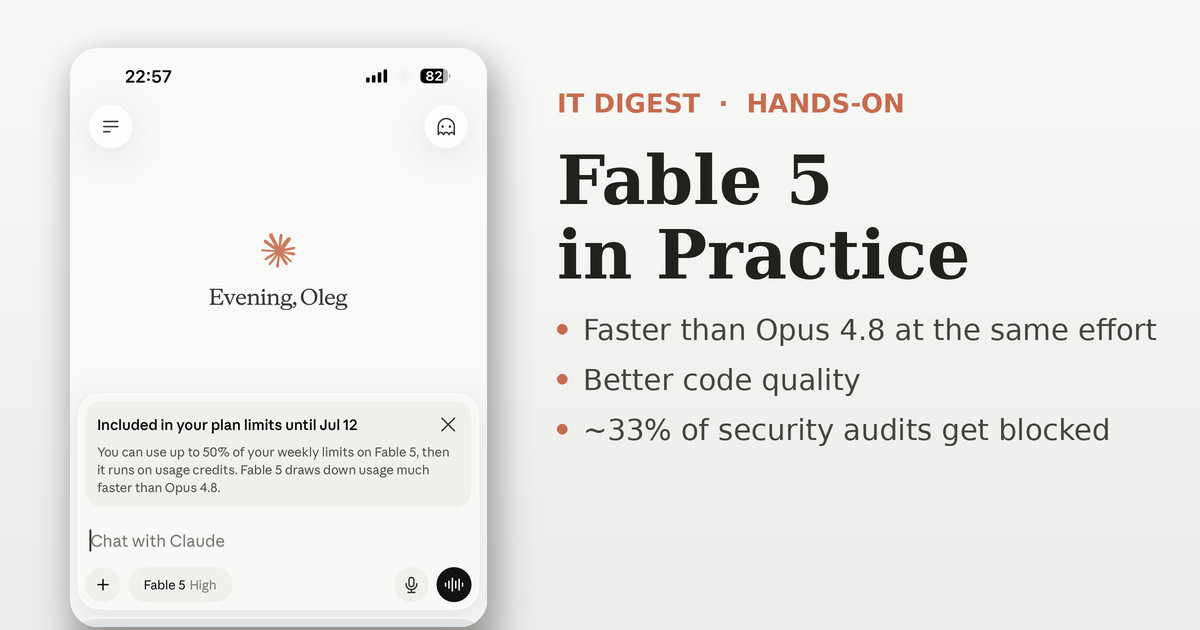
I've been running Claude Fable 5 as my daily driver since it came back online, across real Go, PHP, and Drupal work — not benchmarks. Short verdict: it's the best coding model I've used, with two wins that show up immediately and one recurring annoyance that you need to plan around.
Win #1: Faster than Opus 4.8 at the same effort level
This is the difference you feel first. At the same effort setting — I run it on High — Fable 5 reaches a working result noticeably faster than Opus 4.8. Not "faster" in some abstract benchmark sense: fewer turns to a correct answer, less back-and-forth, less babysitting. Tasks that used to take a few rounds of nudging with Opus land closer to one-shot.
There's a nuance worth flagging, and Claude's own app is upfront about it: Fable 5 draws down your usage much faster than Opus 4.8. On the Pro/Max plans it's included for up to 50% of your weekly limits (for me, until July 12), then it runs on usage credits. So "faster" cuts both ways — quicker to a result, but quicker to burn quota. For the kind of work I do, the time saved is worth the trade. If you run huge volumes, watch the meter.
Win #2: Much better code quality
The bigger deal for me is quality. Fable 5's output is a clear step up — cleaner structure, more idiomatic code, closer to production-ready on the first pass. With Opus 4.8 I'd routinely do a cleanup round: tighten error handling, fix a leaky abstraction, re-do something that technically worked but wasn't how I'd write it. With Fable 5 that rework is smaller and rarer. It reads like it understood the intent, not just the prompt. For refactors and greenfield modules, this is the whole game.
The catch: it refuses to run security audits ~1 in 3 times
Here's the one that will bite you if your workflow touches security. In my use, roughly a third of the time Fable 5 simply won't run a security audit. Not because it lacks the capability — because its internal safeguards flag the request and hand it off to Opus 4.8 instead.
This isn't random. When Anthropic redeployed Fable 5, it deliberately widened the cybersecurity "safety margin" — the classifier is tuned to block a band of likely-benign requests to be sure it catches the genuinely dangerous ones, and it explicitly flags more routine coding, debugging, and security-adjacent tasks as a result. A security audit sits right in that blast radius. So about one in three of mine gets bounced, and I'm told it's been rerouted to Opus 4.8.
In practice that makes Fable 5 unreliable for security-audit workflows specifically. The fallback to Opus 4.8 is still capable, but it's a different model with a different feel, and the hand-off is unpredictable — you can't count on Fable for that job. I keep a separate path ready (Opus directly, or another tool) for anything audit-shaped.
Bottom line
For building and refactoring, Fable 5 is my default now — faster to a result and materially better code than Opus 4.8 at the same effort. For security auditing, treat it as unreliable until Anthropic tunes the false-positive rate down: budget for the ~33% refusal and have a fallback wired in. Two clear wins, one clear caveat — and knowing exactly where the caveat lives makes it easy to work around.
Based on hands-on use of Claude Fable 5 (High effort) since its July 1 redeployment. Context on the widened cyber classifier: Anthropic — Redeploying Claude Fable 5.